
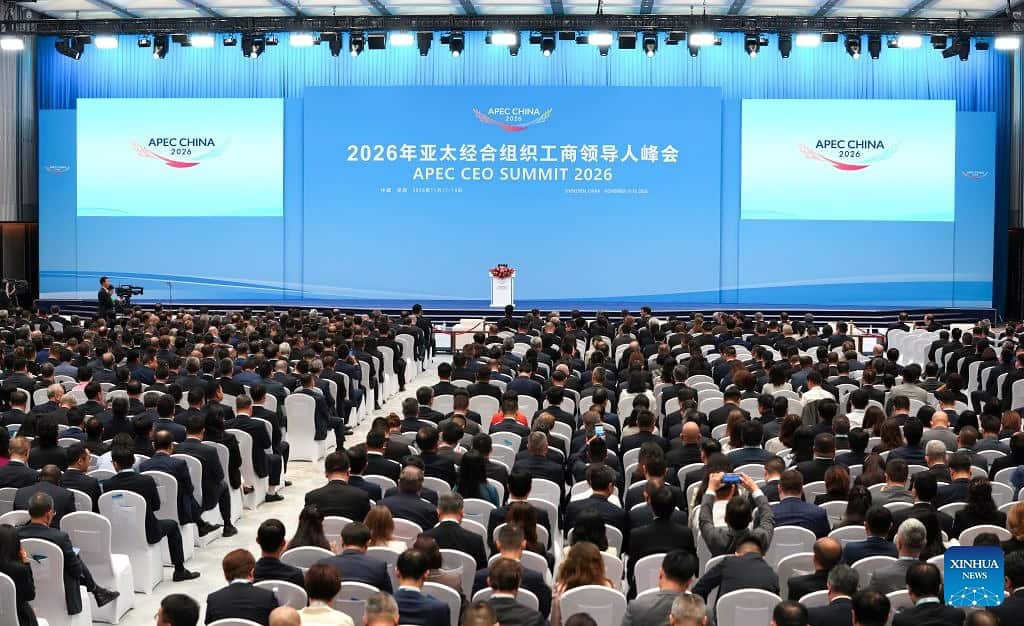
The APEC CEO Summit 2026 concluded in Shenzhen after bringing together more than 2,000 political and business leaders to discuss trade, artificial intelligence, digitalisation, sustainable development and economic integration across the Asia-Pacific.
Held on 17 and 18 November at the Qianhai International Convention Center, the summit attracted representatives from all 21 APEC economies and 13 economies outside APEC. Participating markets beyond the APEC region included the United Kingdom, France, Germany and Switzerland.
The summit concluded with the release of the Shenzhen Initiative, the first time in the event’s 30-year history that its business-community outcomes have been presented in the form of an initiative.
APEC CEO Summit 2026 at a glance
- Dates: 17–18 November 2026
- Venue: Qianhai International Convention Center, Shenzhen
- Participants: More than 2,000
- APEC economies represented: All 21
- Additional economies represented: 13
- Corporate and association leaders participating in discussions: More than 40
- Theme: To Prosper and Win the Future Together
- Host: China Council for the Promotion of International Trade
- Main outcome: APEC CEO Summit Shenzhen Initiative 2026
- Next host economy: Vietnam
The final attendance was consistent with the organiser’s pre-event forecast covered in ChinaExpoHub’s APEC CEO Summit 2026 preview.
Shenzhen Initiative sets out four business priorities
The APEC CEO Summit Shenzhen Initiative 2026 organised its recommendations around four broad priorities:
- Openness and inclusiveness
- Innovation-driven growth
- Greater regional connectivity
- Mutually beneficial cooperation
The initiative calls for closer economic integration, fewer trade barriers, more resilient supply chains and stronger cooperation on artificial intelligence, digital infrastructure and sustainable development.
It also supports continued work towards a proposed Free Trade Area of the Asia-Pacific, commonly known as FTAAP.
The initiative is significant as an expression of business-community priorities, but it does not itself change tariffs, customs rules or market-access requirements. Implementation would require subsequent action by individual APEC economies or agreement through relevant regional and international institutions.
International companies should therefore treat the document as a policy signal rather than a legally enforceable trade agreement.
Trade and regional integration remain central
Trade openness featured prominently throughout the summit.
Discussions addressed tariff and non-tariff barriers, regulatory coordination, customs modernisation and the stability of regional supply chains. Participants also considered how digital trade systems and smarter customs procedures could make cross-border commerce more efficient.
APEC cooperation is based on non-binding commitments and consensus. The organisation does not negotiate enforceable trade rules in the same way as a formal free-trade agreement.
However, its discussions can influence future national policies, regional agreements and technical cooperation between member economies. Companies operating across multiple Asia-Pacific markets should monitor whether the summit’s priorities lead to practical programmes involving:
- Digital customs documentation
- Cross-border electronic commerce
- Supply-chain data exchange
- Trade facilitation for small businesses
- Mutual recognition of standards
- Transport and logistics connectivity
- Simplified administrative procedures
The commercial importance of these initiatives will depend on their subsequent design and adoption.
AI moves higher on the regional business agenda
Artificial intelligence was one of the summit’s major discussion areas.
Sessions examined how the Asia-Pacific can develop a more open and inclusive AI ecosystem while expanding the technology’s use across traditional and emerging industries.
The Shenzhen Initiative reportedly calls for greater support for AI adoption among small, medium and micro-sized enterprises. Possible measures include pilot projects, shared digital infrastructure, capability development and industry-specific applications.
For smaller companies, the main barriers to AI adoption often extend beyond access to software. They may include data quality, employee skills, integration costs, cybersecurity, regulatory uncertainty and limited access to computing infrastructure.
Regional programmes that address these practical constraints could be more useful than general commitments to encourage AI innovation.
Companies should watch for follow-up initiatives in areas such as:
- AI training programmes for SMEs
- Access to shared computing resources
- Cross-border rules for data and digital services
- AI standards and governance
- Industry demonstration projects
- Research and commercialisation partnerships
No detailed regional AI funding programme or binding governance framework was announced at the CEO Summit.
Xi Jinping outlines China’s business priorities
Chinese President Xi Jinping attended the opening ceremony and delivered a keynote address on 18 November.
His speech called for stable regional supply chains, support for the multilateral trading system and deeper cooperation in digital trade, artificial intelligence and green development.
He also presented China’s 15th Five-Year Plan as a source of opportunities for international companies, highlighting areas including new-energy vehicles, smart homes, the silver economy, robotics, autonomous driving and drone delivery.
The speech stated that China would continue expanding market access and opening parts of its service economy while working to improve rules, regulations and standards.
These statements provide an indication of policy direction, but they do not specify implementation dates, eligible industries or individual regulatory changes. Businesses should verify sector-specific rules before making investment or market-entry decisions.
The full address is available through the Chinese government website.
Shenzhen and the Greater Bay Area gain international visibility
Holding the summit in Shenzhen placed the Guangdong–Hong Kong–Macao Greater Bay Area at the centre of regional business discussions.
Shenzhen is a major base for telecommunications, electronics, electric vehicles, drones, robotics, software and advanced manufacturing. Its proximity to Hong Kong also gives companies access to international finance, professional services and logistics networks.
The summit explored how the Greater Bay Area could support wider Asia-Pacific development through technology, trade and investment connections.
China also proposed establishing a World Association for Bay Areas Economic Cooperation. Public details about its membership, governance and operating programme remain limited, so companies should wait for further information before assessing its potential commercial relevance.
International executives evaluating the region may benefit from considering different cities according to their strengths:
- Shenzhen: Technology, hardware development and innovation
- Dongguan: Manufacturing and supply-chain integration
- Guangzhou: Trade, services, automotive and commercial connections
- Hong Kong: Finance, legal services, fundraising and international expansion
- Zhuhai: Advanced manufacturing, aviation and links with Macao
ChinaExpoHub’s report on the Greater Bay Area Conference 2026 provides additional context on the region’s positioning in finance, technology and international business.
Digital and green transformation discussed together
The summit connected digital development with the region’s transition towards lower-carbon economic growth.
Discussions covered renewable and emerging energy, sustainable infrastructure and the use of digital tools to improve industrial efficiency.
The Shenzhen Initiative calls for coordination involving traditional, renewable and new energy sources. It also addresses energy infrastructure and cooperation on energy-security information.
These priorities could generate opportunities for companies working in:
- Renewable-energy equipment
- Energy storage
- Smart grids
- Industrial software
- Carbon-management systems
- Electric mobility
- Sustainable logistics
- Green finance
- Energy-efficiency technology
The summit did not announce specific procurement contracts or investment projects in these sectors. Companies should look for follow-up programmes from national governments, local authorities, development institutions and participating corporations.
No investment or contract totals were announced
Although the summit attracted senior political and corporate leaders, the organiser’s final report did not disclose an aggregate value for contracts, investments or commercial agreements concluded during the event.
The summit’s immediate value therefore lies primarily in:
- Senior-level dialogue
- Policy signalling
- Relationship building
- Business advocacy
- Regional agenda setting
- Identification of future cooperation areas
It should not be evaluated using the same criteria as a trade exhibition designed around supplier discovery and purchase orders.
For international companies, the most useful next step is to identify which summit recommendations relate to their industry and monitor whether they lead to concrete rules, pilot programmes, tenders or business partnerships.
Vietnam takes over the next summit
At the closing ceremony, CCPIT Chairman Ren Hongbin passed the next APEC CEO Summit hosting role to Nguyen Quang Vinh, vice chairman of the Vietnam Chamber of Commerce and Industry.
Vietnam’s role as the next host may bring additional attention to ASEAN manufacturing, digitalisation, energy development and regional supply-chain integration.
Companies operating between China and Southeast Asia should monitor the next summit programme for opportunities involving:
- China–ASEAN supply chains
- Regional manufacturing diversification
- Cross-border logistics
- Digital trade
- Clean energy
- Technology cooperation
- SME participation in regional commerce
The official APEC CEO Summit 2026 website provides further information about the Shenzhen event.
Companies looking for sector-specific exhibitions and supplier meetings in Shenzhen can explore the China trade show calendar.


