
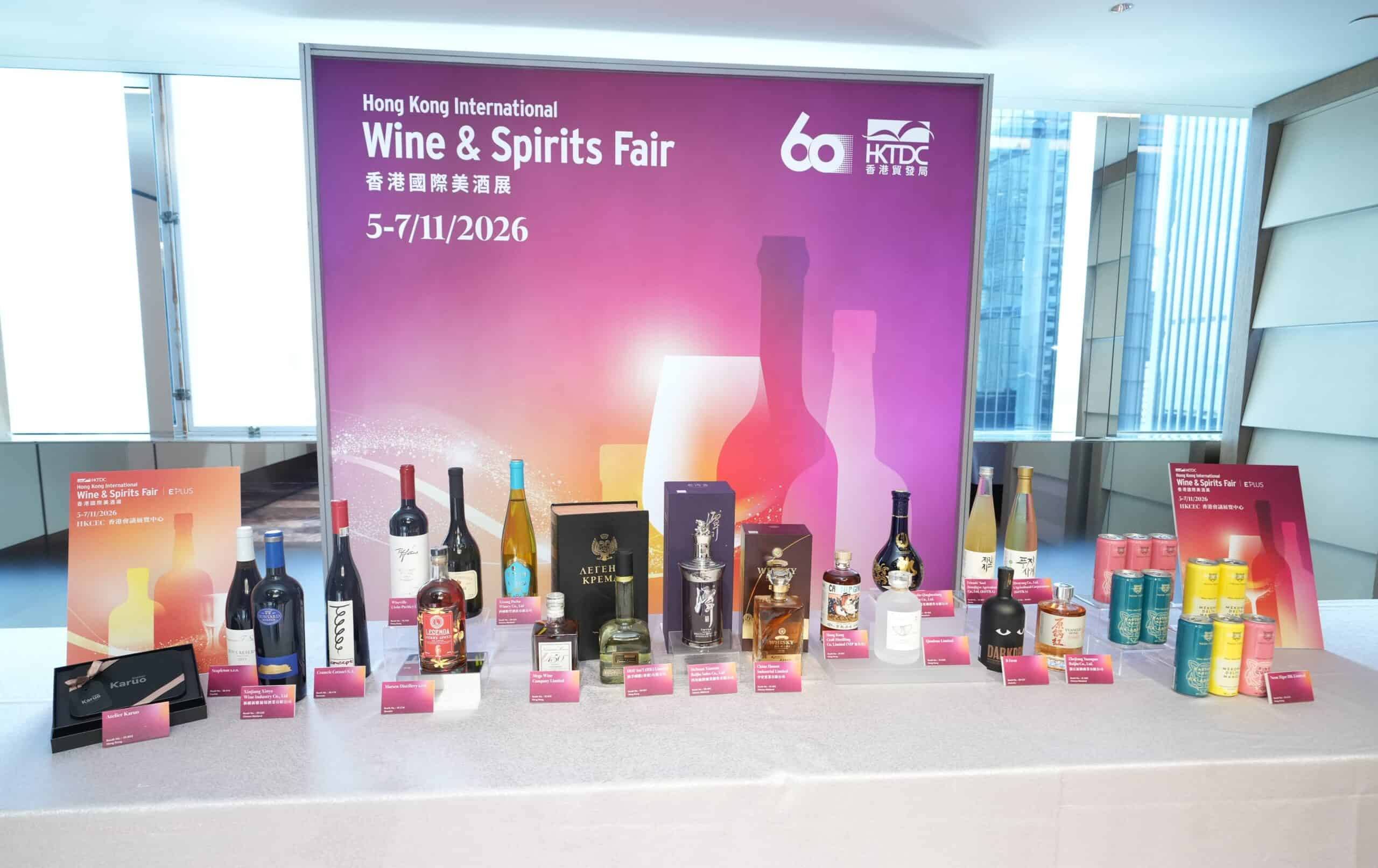
The Hong Kong International Wine & Spirits Fair 2026 will bring more than 620 exhibitors from over 25 countries and regions to the Hong Kong Convention and Exhibition Centre from 5 to 7 November 2026.
Organised by the Hong Kong Trade Development Council, the 18th edition will present wines, spirits, sake, beer and low- and no-alcohol drinks representing more than 40 places of origin.
The expanded World of Spirits zone and the participation of major Chinese baijiu producers give this year’s event a particularly strong focus on premium spirits and the international expansion of Chinese drinks brands.
Hong Kong Wine & Spirits Fair 2026 at a glance
- Dates: 5–7 November 2026
- Venue: Hong Kong Convention and Exhibition Centre
- Exhibitors: More than 620
- Exhibiting countries and regions: More than 25
- Product origins represented: More than 40
- Industry events: More than 40
- Online Click2Match period: 29 October–14 November 2026
- Public programme: Saturday Fiesta on 7 November
The physical exhibition will occupy Halls 3C, 3D and 3E. International buyers can consult the official fair overview for opening hours and online matching arrangements.
World of Spirits expands to 16 participating markets
The returning World of Spirits zone will include exhibitors from 16 countries and regions. Mexico, Portugal, Slovakia and the United Kingdom are participating in the zone for the first time.
Products will cover eight major spirit categories:
- Baijiu
- Whisky
- Vodka
- Rum
- Tequila
- Brandy and cognac
- Gin
- Soju
The range gives importers, distributors, retailers, hospitality groups and bar operators an opportunity to compare established categories with products from less familiar producing markets.
Central and Eastern European participation includes King Barley Single Malt Whisky from Czechia and Legenda Cherry Spiced Rum from Slovakia. These products illustrate how the fair is being used by smaller producers seeking distribution beyond their domestic and neighbouring markets.
Buyers evaluating unfamiliar brands should look beyond packaging and tasting-room appeal. Commercial considerations include production capacity, export documentation, available certifications, wholesale pricing, minimum orders and whether a producer can support sustained marketing in the destination market.
Chinese baijiu brands look towards international markets
Chinese baijiu is one of the most prominent product categories at the 2026 fair.
The organiser says a group presented as the “Top 10 Chinese Baijiu Brands” will participate, including Kweichow Moutai and Yanghe. Because the announcement does not identify an independent ranking methodology, buyers should treat the description as the name of the fair’s promotional group rather than a separately verified industry ranking.
A seminar titled “Chinese Baijiu Go Global” will examine the opportunities and difficulties facing producers expanding overseas. An interactive installation will also introduce traditional production methods and the cultural history of baijiu.
For baijiu producers, international expansion requires more than identifying importers. Important challenges include:
- Explaining unfamiliar aroma categories to consumers
- Adapting bottle sizes and alcohol levels
- Building restaurant, bar and specialist-retail distribution
- Meeting local labelling and food-safety requirements
- Protecting trademarks in overseas markets
- Developing serving occasions beyond traditional Chinese banquets
- Providing consistent English-language sales and training materials
Xiantan Distillery, for example, is presenting a 39% ABV baijiu and a 100ml bottle intended to make the category more accessible to younger and first-time consumers. The company has identified Southeast Asia and Europe as priority markets, according to the organiser.
Another product, described as a sauce-flavoured whisky, combines baijiu-style sauce aroma with malt-whisky characteristics. Such hybrid products may help producers attract curious consumers, although importers will need to determine how they should be classified, labelled and positioned in their destination markets.
Hong Kong’s spirits duty change strengthens the commercial context
The stronger focus on spirits comes after Hong Kong changed its duty structure for higher-value liquor in October 2024.
For liquor with an import price above HK$200, the duty on the portion exceeding HK$200 was reduced from 100% to 10%. The first HK$200 remains subject to the existing rate. This means the measure primarily benefits higher-value products rather than all imported spirits. The structure is explained in a Hong Kong Legislative Council report.
The same report found that Hong Kong’s spirits imports reached HK$6.48 billion in 2024, surpassing wine imports for the first time since 2007. It also reported that duty-paid imported spirits increased substantially during the first months following the change, although longer-term data will be needed to determine its lasting effect.
For overseas distilleries, the revised duty structure may improve Hong Kong’s attractiveness as a market for premium products, auctions, storage and regional distribution. It does not remove the need to calculate duties, logistics costs and taxes separately for any products subsequently shipped to the Chinese mainland or other Asian markets.
Chinese wines gain a larger international platform
The wine section will feature established producing countries alongside newer and less widely distributed origins.
Georgia and Italy’s Calabria region will participate through dedicated pavilions for the first time. Producers from Czechia and Romania will also present wines made from regional grape varieties and terroirs.
Chinese wines from Xinjiang, Ningxia and Xizang will be marketed to international buyers. Featured products include a high-altitude wine from Xizang and red wines from Xinjiang.
Recent trade data provides some context for this increased visibility. Hong Kong wine imports were valued at HK$4.7 billion during the first eight months of 2026, an increase of 16.2% from the corresponding period a year earlier. Wines originating from the Chinese mainland accounted for 6.3% of import value, with their value increasing by 101.5%, according to HKTDC Research.
The rapid percentage increase began from a relatively small market share, so it should not be interpreted as Chinese wine overtaking established sources such as France or Australia. It does, however, indicate growing commercial interest in mainland wine regions.
International buyers assessing Chinese wines should consider:
- Vineyard and winery location
- Grape variety and vintage consistency
- Geographical indications
- Production and storage capacity
- Independent awards and tasting results
- Export experience
- English-language labelling
- Trademark availability
- Pricing relative to better-known origins
Low- and no-alcohol drinks widen the buyer base
The exhibition will also feature low- and no-alcohol beverages, fruit sodas and other products aimed at consumers seeking alternatives to conventional alcoholic drinks.
This section could be relevant to supermarkets, hotels, restaurants, cafés and distributors that want to expand their drinks selection without focusing exclusively on wine and spirits.
Buyers should confirm how a product is classified in their home market. Definitions of “alcohol-free”, “non-alcoholic” and “low-alcohol” can vary between jurisdictions, particularly when a drink retains a small amount of alcohol after production.
Product formulation, sugar content, shelf life, cold-chain requirements and the use of health-related marketing claims should also be checked before placing orders.
More than 40 events support product evaluation
More than 40 seminars, tastings, masterclasses and networking events are planned during the exhibition.
Masters of Wine Debra Meiburg, Bill Liu and Jennifer Docherty will participate in professional masterclasses. The returning Sommeliers’ Picks programme will use blind tastings to identify selected products for buyers and consumers.
Cocktail-related activities will feature representatives from several Hong Kong bars, while the Hong Kong International Mixology Showdown will hold competitions for Hong Kong and the Greater Bay Area.
For trade buyers, guided tastings can be useful for creating an initial shortlist. However, a positive tasting result should be followed by commercial due diligence covering landed costs, distributor margins, marketing support, availability and repeat-order capacity.
Buyers should also use the official exhibitor directory to identify suppliers before travelling. The online directory may display fewer companies than the organiser’s announced total because it only includes exhibitors that have submitted complete profile information.
Who should attend the fair?
The Hong Kong International Wine & Spirits Fair is particularly relevant to:
- Wine and spirits importers
- Regional distributors
- Supermarkets and specialist retailers
- Hotels, restaurants and catering groups
- Bar operators and beverage directors
- E-commerce platforms
- Duty-free and travel-retail buyers
- Corporate and private-label buyers
- Logistics and bonded-warehouse companies
- Wine investors and auction businesses
- Producers looking for Asian distributors
International buyers should arrange priority meetings before arriving. Useful information to request in advance includes wholesale price lists, export markets, production capacity, minimum order quantities, exclusivity conditions and available product certifications.
Combine the trip with the Hong Kong Optical Fair
The Hong Kong International Optical Fair 2026 will take place at the same venue from 4 to 6 November, overlapping with the Wine & Spirits Fair on 5 and 6 November.
Although the two exhibitions target different industries, international trading companies, retail groups and business delegations with broader sourcing interests may be able to attend both during one Hong Kong visit.
Visitor information for the concurrent event is available on the Hong Kong Optical Fair 2026 event page.
Saturday Fiesta opens part of the fair to consumers
The designated Saturday Fiesta public zone will open on 7 November to visitors aged 18 or above.
Standard admission is HK$220. Promotional tickets are available for HK$128 through selected platforms until 6pm on 6 November, subject to the organiser’s terms and availability.
The consumer programme includes tastings, product sales and cocktail-related activities. Trade buyers should note that this is a designated public section rather than unrestricted public access to all professional sourcing areas.
What makes the 2026 edition commercially relevant?
The 2026 exhibition is similar in overall scale to the previous edition, which recorded 621 exhibitors and 8,219 physical buyers from 57 countries and regions. However, the number of exhibiting markets has increased from 23 in 2025 to more than 25 in 2026, based on organiser figures.
Three developments are particularly relevant for international buyers:
- The World of Spirits is expanding, supported by Hong Kong’s revised duty treatment for higher-value liquor.
- Chinese baijiu and wine producers are pursuing overseas markets, creating distributor and market-entry opportunities.
- Products are becoming more varied, from regional European wines and premium spirits to hybrid drinks and low-alcohol alternatives.
The strongest opportunities are likely to be found by buyers who arrive with a defined category, target price range and distribution model rather than attempting to taste or evaluate the entire exhibition.
The Hong Kong International Wine & Spirits Fair 2026 runs from 5 to 7 November at the Hong Kong Convention and Exhibition Centre. Further exhibitions can be found in the China trade show calendar.


