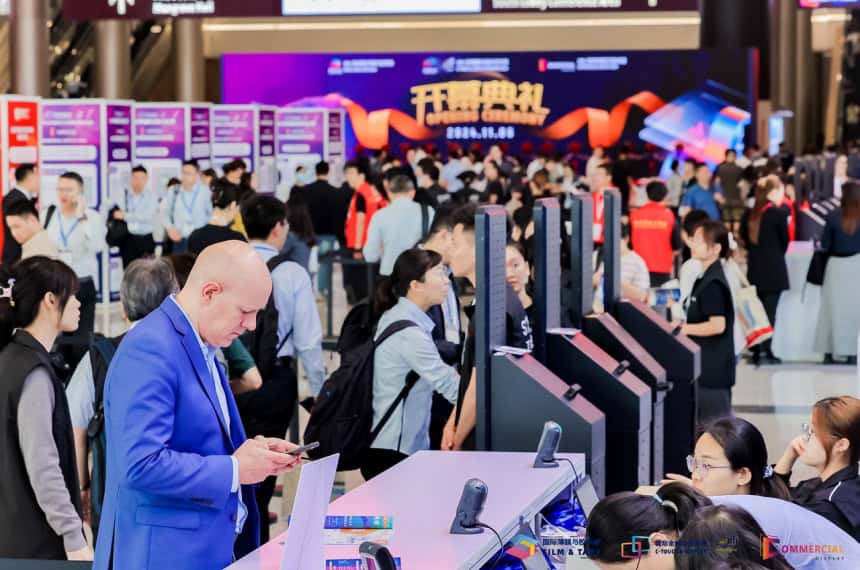

The Canton Fair is marking its 70th anniversary with Chasing the Light, a buyer-focused documentary tracing how encounters in Guangzhou have developed into long-term commercial relationships across generations.
Released alongside the opening of the 140th China Import and Export Fair, the film shifts attention away from exhibition statistics and product displays to the people who have shaped the event: international buyers, business chambers and technology entrepreneurs.
Produced by Xufang International Media under China International Communications Group, Chasing the Light tells its story through four chapters—First Encounter, Trust, Co-Creation and Leap. Together, they present the Canton Fair as more than a sourcing venue: a place where introductions can grow into partnerships and where buyer demand can influence the development of Chinese manufacturing.
Watch ‘Chasing the Light’
The Canton Fair’s 70th-anniversary documentary can be watched below.
The documentary is also available through the official YouTube video.
Four chapters trace the development of trade relationships
Rather than presenting the fair’s history as a chronological list of sessions, Chasing the Light structures its narrative around four stages in an international business relationship.
First Encounter
Every buyer-supplier relationship starts with an introduction.
At a large exhibition such as the Canton Fair, that first encounter may happen through a product demonstration, a discussion at a booth or an introduction arranged by a chamber of commerce.
The First Encounter chapter represents the moment when an overseas buyer discovers a potential supplier or sees a product that could work in another market.
An initial meeting does not guarantee a successful order. Buyers still need to examine product quality, pricing, certification, manufacturing capacity and communication. However, meeting face to face can provide context that is difficult to obtain from an online product listing alone.
Trust
The second chapter focuses on trust, one of the most important elements in international sourcing.
Trust develops through consistent quality, reliable delivery, transparent communication and the ability to resolve problems when they occur. It is rarely established through a single meeting.
The Canton Fair’s twice-yearly schedule has enabled buyers and suppliers to meet repeatedly, review new products and maintain relationships over extended periods. Some buyers have returned to Guangzhou across multiple generations of their family businesses.
Ahead of the anniversary session, the fair invited veteran overseas buyers to contribute their memories and stories. The official call for buyer stories described relationships between the fair and international buyers that have developed over several decades.
The documentary’s emphasis on trust is therefore commercially significant. International trade depends not only on finding a product but also on confidence that the supplier can maintain standards after an order has been placed.
Co-Creation
The Co-Creation chapter reflects a change in the relationship between Chinese manufacturers and international buyers.
Buyers do not always purchase products exactly as displayed. They may request changes to design, materials, packaging, functions, certification or branding. Manufacturers, in turn, can contribute engineering expertise, production knowledge and ideas based on their supply-chain capabilities.
This process can move the relationship beyond conventional purchasing towards joint product development.
The buyer brings knowledge of customer expectations and regulatory requirements in the target market. The manufacturer contributes production capacity and technical expertise. When the relationship works well, both sides participate in creating a product suited to a specific commercial opportunity.
This model is particularly relevant to private-label, original equipment manufacturing and original design manufacturing projects. It also explains why face-to-face discussions remain valuable even when products and suppliers can be discovered online.
Leap
The final chapter, Leap, connects the fair’s history with changes in Chinese manufacturing and international trade.
When the Canton Fair began, its role was primarily to introduce Chinese export products to international markets. Today, buyers encounter smart devices, industrial automation, electric vehicles, service robots, green technology and increasingly specialised manufacturing solutions.
The documentary presents this development as a movement from initial market access towards innovation, international collaboration and technology-led growth.
The 140th session reflects that transition through products associated with artificial intelligence, digital manufacturing, renewable energy and lower-carbon production. The fair is also introducing more digital services to help buyers navigate its extensive exhibition areas and identify suppliers.
From 1,200 buyers to a global sourcing platform
The Canton Fair was established in the spring of 1957 and has since been held every spring and autumn in Guangzhou.
According to the official Canton Fair history, the exhibition has maintained trade relationships with more than 229 countries and regions and has continued without interruption across 140 sessions.
The first edition covered approximately 9,600 square metres and attracted around 1,200 buyers. Seventy years later, the 140th session covers approximately 1.55 million square metres across its three phases.
At a September briefing, organisers described this growth as part of the fair’s transformation from an early export exhibition into a large international trade platform. The 140th Canton Fair briefing also highlighted more than 75,000 booths and new digital services intended to support buyers.
The official 70th-anniversary visual identity uses a continuous red-and-gold ribbon to form the number 140. According to the Canton Fair’s anniversary announcement, the design represents continuity, friendship and trade connections extending across borders.
Chasing the Light gives that visual idea a human dimension by focusing on the people behind those connections.
Why buyers are central to the documentary
Trade-show anniversary content often focuses on organisers, buildings and headline attendance figures. This documentary instead places international buyers near the centre of the story.
That choice reflects the role buyers play in the development of an export exhibition.
Buyers bring information about:
- Customer preferences in overseas markets
- Product and packaging requirements
- International safety and quality standards
- Changes in retail and distribution
- Emerging demand in specific countries
- Areas where existing products need improvement
Their feedback can influence what manufacturers develop and how products are adapted for international markets.
Buyers also carry information in the other direction. They introduce new products, suppliers and manufacturing capabilities to distributors, retailers and customers in their home markets.
The documentary’s four-stage structure—encounter, trust, co-creation and leap—captures how this exchange can develop over time.
The 140th Canton Fair continues across three phases
The documentary was released as the 140th Canton Fair opened in Guangzhou. The autumn session runs from October 15 to November 4, 2026, across three product-focused phases.
Canton Fair Phase 1 runs from October 15–19 and covers advanced manufacturing, electronics, machinery, vehicles, new energy, hardware and industrial products.
Canton Fair Phase 2 takes place from October 23–27, focusing on housewares, furniture, building materials, gifts, decorations and other home-related products.
Canton Fair Phase 3 follows from October 31 to November 4 and covers fashion, textiles, food, healthcare, medical devices, baby products, toys, personal care and recreation.
Buyers should select the phase that matches their sourcing requirements because most product categories appear only during their designated dates.
A documentary about relationships, not only trade
Chasing the Light presents the Canton Fair’s anniversary through the relationships that have developed around it.
Products, technologies and exhibition halls have changed substantially since 1957. The underlying commercial process remains more familiar: people meet, evaluate one another, build confidence and explore what they can create together.
That is the documentary’s most relevant message for today’s international buyer. Successful sourcing is not simply about finding the lowest price or the newest product. It depends on identifying suitable partners, establishing trust and developing relationships capable of adapting as markets change.
After 70 years, the Canton Fair continues to provide a setting in which those first encounters can take place.